The Vineyard's Story Uncorked
April 6, 2025
What Makes Wine Unforgettable?
At Small Vines, we make every decision with one goal in mind: quality over quantity. Our team cultivates just 3,630 vines per acre, and each vine yields only 0.75 to 1.5 pounds of fruit, about one-fifth of California’s average. We don’t do this by chance; we do it by design.
Drawing inspiration from Burgundy’s famed 1-meter vine spacing, we tailored the concept to suit Sonoma’s conditions. We refined the spacing to 4 feet by 1 meter, encouraging a taller canopy that naturally shades the fruit during heat spikes. This approach preserves acidity and promotes balance. The result? Pinot Noirs and Chardonnays with remarkable depth, precision, and a profound sense of place.
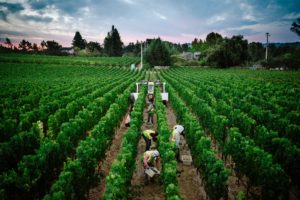
Our journey began in 1995 with a clear vision: to craft wines that honor both patience and provenance. By tightening vine spacing, we push roots deeper and allow vines to experience gentle stress. This produces lower yields but delivers intensely flavored, character-rich fruit. While many California vineyards harvest 5–7 pounds per vine, we choose to harvest less because fewer grapes create more complex wines.
We’ve already seen exciting results from our high-density plantings. Fruit quality continues to rise, and we expect this to translate into wines with even greater structure and complexity. Based on what we’ve learned from similar vineyards, we anticipate a number of key benefits:
- Naturally concentrated wine
- Better natural shading for the canopy, fruit, and vineyard floor
- Balanced crop load across the vineyard
- Stronger lignification of canes, clusters, and berry stems
- Smaller berries and more compact clusters
We call this intentional viticulture. It’s sustainable, hand-tended, and intensely focused. Our team makes every choice, from canopy management to harvest timing, to capture the vineyard’s unique identity in each bottle. This hands-on approach helps us handle climate stressors like sunburn and vine fatigue, and it allows us to dry farm our vineyards with confidence.
Collectors, this is your wine. Our next small-lot release, featuring micro-block gems from TBH Vineyard, arrives this fall. Each bottle tells a story of place, precision, and passion. Join our mailing list for early access before these limited releases are gone.
At Small Vines, less isn’t just more. It’s everything.
May 6, 2025
The Delicate Art of Pinot Noir Winemaking in Sonoma County
Today I dove deeper into Pinot Noir, and more specifically, why its delicate nature challenges winemakers just as much as it rewards them. In regions like Sonoma County, California, where cool coastal influences and diverse soils shape every vine, producers like Small Vines meet this challenge with precision, intention, and care.
At Small Vines, the team hand-harvests every cluster of Pinot Noir. The grape’s thin skins make it especially fragile, so timing is everything. Pick too early, and the result is overly acidic, lightweight wine. Pick too late, and you risk losing freshness and balance. That’s why Small Vines carefully monitors canopy development and ripening across its densely planted vines, each one producing small, concentrated yields that lead to balanced, expressive wines.
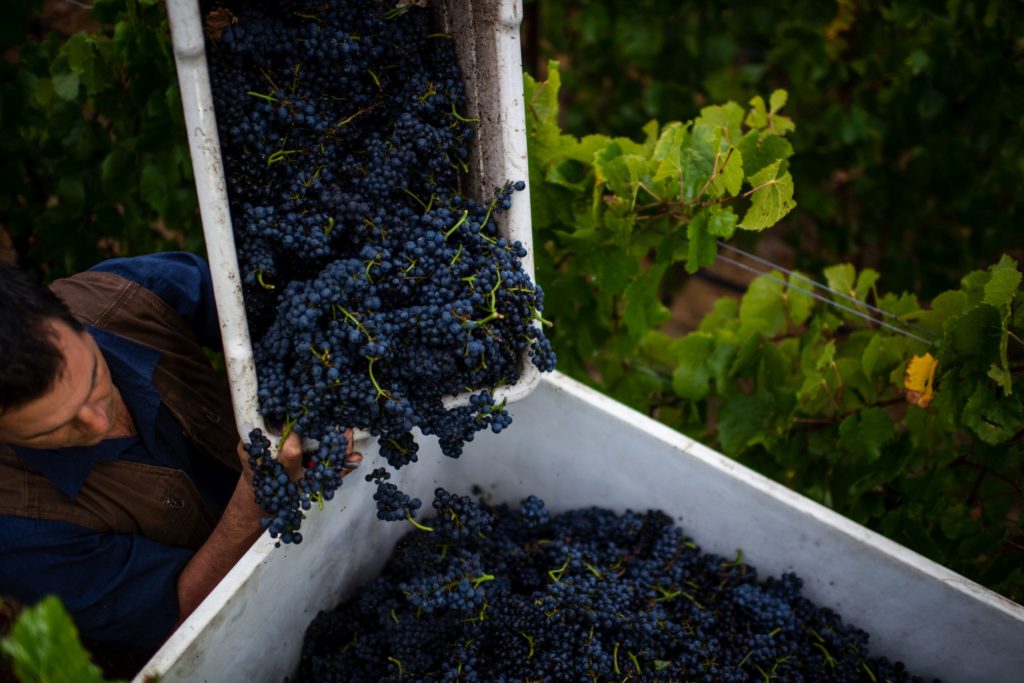
One technique that really stood out is whole bunch fermentation. Small Vines uses this method selectively, depending on the vineyard site, clone, and vintage. By fermenting with intact clusters, the winemaking team builds more structure, spice, and aromatic depth into the wine. The stems contribute earthy, herbal notes and firmer tannins, adding definition to Pinot Noir’s elegant frame. Some berries even undergo carbonic maceration inside the cluster, which lifts the aromatics with fresh red fruit notes like cherry and strawberry. But this only works when the stems are fully lignified, a condition Sonoma’s balanced climate can often achieve in the right years.
Throughout fermentation, the team manages the cap with manual punch-downs to gently extract flavor and avoid harsh tannins. Afterward, they press the wine off the skins and move it to neutral barrels, where it gains texture and spice without overwhelming the purity of fruit.
Pinot Noir demands both discipline and intuition. It’s no wonder winemakers call it the “heartbreak grape.” But when grown and handled with care, it produces something extraordinary wines that are nuanced, expressive, and deeply rewarding.
June 4, 2025
Burgundy Is a Place, Not a Style
If you’ve ever searched for a Burgundian-style Pinot Noir or a Burgundian-style Chardonnay from Sonoma, you’re not alone. We hear this request often from curious wine lovers looking for elegance, finesse, and a sense of place in their glass. But let’s unpack the phrase. What does “Burgundian-style” actually mean? And can a wine from California ever truly capture the spirit of Burgundy?
Here’s the truth: Burgundy is not a style. It’s a place.
Located in eastern France, just south of Dijon and north of Lyon, Burgundy is one of the most revered wine regions in the world. It’s the spiritual home of Pinot Noir and Chardonnay, and its reputation is built not on flashy winemaking, but on a deep-rooted commitment to terroir, the idea that the character of a wine is shaped by the soil, climate, aspect, and culture of its vineyard. Burgundy is about subtlety, precision, and transparency. Its wines are known for their restraint, balance, and ability to tell the story of the land they come from.
When people refer to “Burgundian-style” wines, they’re often trying to capture that same philosophy. They’re looking for cool-climate Pinot Noir with bright red fruit, silky texture, and earthy undertones. They’re drawn to Chardonnay that balances minerality with acidity and shows elegance over power. They seek wines that are light-handed in the cellar, often fermented with native yeasts and aged in neutral or lightly used French oak, allowing vineyard expression to shine through. In short, they’re seeking terroir-driven wines made with intention and care.
Burgundy itself is diverse, and there is no single “Burgundian style.” A flinty, high-acid Chardonnay from Chablis is worlds apart from the rich, layered whites of Meursault or Puligny-Montrachet. A floral, ethereal Pinot Noir from Chambolle-Musigny has little in common with the structured, brooding reds of Gevrey-Chambertin or Nuits-Saint-Georges. Even within Burgundy, wine styles vary dramatically by village, vineyard, and winemaker. What unites them is a shared commitment to farming small plots, respecting the land, and crafting wines that speak softly but resonate deeply.
This philosophy resonates strongly at Small Vines Wines. Wine writer Brad Horn has noted that Paul Sloan’s high-density planting approach is unusual for Sonoma County and central to the distinctiveness of these wines. After years of searching for the ideal site, one with cooling coastal influence, well-drained low-vigor soils, and a ridge-top position, Paul and his wife Kathryn established their first estate in 2007. Their winemaking is firmly rooted in tradition, focused on purity, transparency, and wholesomeness, drawing inspiration from France’s centuries of wine heritage. Horn has praised the results as among his personal favorites, pointing to their meticulous vineyard work and restrained, terroir-driven style, qualities that often define the very best wines of Burgundy.
Like our Burgundian counterparts, we aim to make wines that express site over style, letting the vineyard guide our decisions in both farming and winemaking. Our vines are tended by hand. Our fermentations rely on native yeasts. And our wines are aged thoughtfully with a light touch so that purity, tension, and structure remain front and center.
The term “Burgundian-style” may be vague, but the intention behind it is clear. It’s about wines that reflect their place. Wines that whisper, not shout. Wines shaped by terroir, not trends. As anthropologist Marion Demossier wrote in Burgundy: A Global Anthropology of Place and Taste, Burgundy has long been seen as “the birthplace of a model of ‘terroir,’ connecting taste to place.” That connection is at the heart of everything we do at Small Vines.
So the next time you reach for a bottle labeled “Burgundian-style,” consider what you’re truly craving: not just a flavor profile, but a philosophy. A commitment to thoughtful farming, minimalist winemaking, and wines that honor their origin. Whether you’re drinking a Grand Cru from the Côte de Nuits or a cool-climate Chardonnay from Sonoma County, the most meaningful wines are those that reflect where they’re from, and who made them.
References:
Demossier, Marion (2018) Burgundy: A global anthropology of place and taste (New Directions in Anthropology, 43), vol. 43, New York.
Berghahn Books, 280pp.
July 8, 2025
Natural Wine vs Low Intervention Wine. What’s the Difference?
About five years ago, natural wine was the darling of the wine world. Bottles with cloudy juice, quirky labels, and a whole lot of funk were everywhere from your neighborhood wine bar to the shelves of trendy bottle shops. But as with many movements, the hype around natural wine has evolved. These days, you’re more likely to hear the term low intervention thrown around instead. So, what happened? Has natural wine fallen out of favor? And what exactly is the difference between natural and low intervention wine?
At its core, natural wine is about purity. The idea is simple: nothing artificial added in the vineyard or during the winemaking process. No pesticides or herbicides, no lab-cultured yeasts, no fining or filtering, and minimal, if any, sulfur. The goal? Let the grapes and nature do the talking. But here’s the catch: there’s no legal definition of natural wine. As wine writer Alice Day noted in 2022:
“As with any natural product, the term natural wine simply indicates that nothing artificial has been added to the grape growing or winemaking processes. Natural winemaking aims to express the essence of wine without interference, and it’s up for interpretation.”
This is where low intervention wine enters the picture. The ethos is similar, let the grapes and terroir speak, but with a bit more flexibility. As Jacob Davis explained earlier this year:
“At the heart of low-intervention winemaking lies a philosophy that emphasizes the natural expression of the grape. Vintners in this realm strive to minimize the use of additives, opting instead for a more hands-off approach that allows the terroir, the complex interplay of soil, climate, and microbiology, to shine through.”
The key difference? Low intervention winemakers might allow for minimal sulfur use or light filtration. They still value purity and transparency, but they’re not opposed to making small adjustments when necessary to protect the wine’s integrity and stability.

The chart above shows this spectrum in practice. Conventional wines allow dozens of additives and higher Sulphur levels, organics cut back, biodynamics go stricter still, and natural wines are the most minimal of all, permitting almost nothing but tiny amounts of Sulphur. Low intervention wines fall between biodynamic and natural, minimal, but with a little more flexibility.
Think of it this way: if natural wine is an unedited documentary, low intervention wine is a thoughtfully cut indie film still authentic, just with a touch more polish. The move from “natural” to “low intervention” reflects a broader evolution in how we think about wine. Consumers have become more informed. They want wines that are honest and environmentally responsible, but also clean, consistent, and delicious. Low intervention offers a middle ground. It respects the same principles as natural winemaking but with a more pragmatic lens. It’s not about being dogmatic; it’s about balance.
The real question isn’t natural vs. low intervention. What do you enjoy drinking? If you love bold, unfiltered wines with a bit of funk and surprise, you may be a natural wine fan. If you appreciate clean flavors, expressive terroir, and a bit more control in the process, low intervention wines might be your match.
In the end, both styles are part of the same movement: a return to thoughtful, honest winemaking that prioritizes the land, the grape, and the people behind the bottle. Whichever you choose, pour a glass, taste slowly, and appreciate the story in every sip.

August 6, 2025
Red vs. White: Which Wine Really Gives You a Worse Hangover?
We’ve all been there: waking up after a few too many glasses of red wine, convinced your skull is both imploding and exploding at the same time. For years, red wine has taken the blame as the ultimate hangover culprit.
But is it really the worst offender? Or is there more to the story when it comes to wine hangovers?
Hangovers are caused by a mix of factors: alcohol, sugar, dehydration, and chemical byproducts of fermentation. These compounds form naturally during fermentation and aging and are found in higher concentrations in darker drinks like red wine. While they add depth to flavor, they can also worsen hangover symptoms.
One of the most problematic chemical byproducts is methanol, which the body converts into formaldehyde and formic acid both toxic and strongly linked to headaches and nausea. Other compounds like fusel alcohols and acetaldehyde also contribute to the fatigue and general “off” feeling many associate with wine hangovers.
In red wine, these compounds are more prevalent, along with tannins and histamines from grape skins. These can cause congestion, or facial flushing, especially in sensitive drinkers. Red wines typically contain more tannins and fermentation byproducts, which may explain their reputation for triggering bad hangovers. But white wines come with their own hangover risks.
Many whites, especially off-dry styles like Riesling or Moscato, contain more residual sugar. That sugar, combined with alcohol, can cause blood sugar spikes and dehydration two key ingredients in a rough morning after. White wines also tend to have more sulfites, which are added to preserve freshness and prevent spoilage. While sulfites are generally harmless for most people, they can trigger reactions in those with sensitivities.
So, while red wines may be heavier in fermentation byproducts, white wines aren’t exactly innocent either.
Champagne might be the sneakiest culprit. Champagne is often thought of as a light and celebratory drink, but it can deliver a particularly brutal hangover. This is due to several factors: the added sugar during the dosage step, the alcohol content, and most importantly the carbonation.
Carbonation accelerates alcohol absorption in your bloodstream, which means you get tipsy faster and often don’t realize how much you’re drinking until it’s too late. The combination of sugar, bubbles, and alcohol makes Champagne uniquely positioned to leave you hurting the next day.
Here’s something you may have never thought about. Are wine additives making hangovers worse? Another piece of the hangover puzzle that often gets overlooked is wine additives. Many commercial wines, especially large-scale or inexpensive ones, include additives that aren’t listed on the label. These can include added sugar or grape concentrate, coloring agents to enhance appearance, acidifiers to adjust balance, both liquid oak and oak dust and fining agents like egg whites or milk proteins to clarify the wine.
While all of these are permitted, they can affect how you feel after drinking. For example, excess sugar increases dehydration. Certain fining agents may cause allergic reactions. And highly processed wines with synthetic yeasts or enzymes might be harder for your body to digest, even in moderate quantities.
In short, the more manipulated the wine, the greater the chance your body might not react well to it. So, what gives the worst hangover?
If you’re prone to migraines or histamine reactions, red wine might hit harder. If you’re sensitive to sugar or sulfites, white wine or Champagne could be the culprit. And if you’re drinking wines that are highly processed or full of hidden additives, you will feel worse. Ultimately, the worst hangovers often come down to what kind of wine you’re drinking, not just the color.
At Small Vines, we believe that how your wine is grown and made matters for both your health and the planet. That’s why we organically practice and generatively farm all of our vineyards, caring for the soil and environment with long-term sustainability in mind. In the cellar, our winemaking approach is low-intervention and intentional.
That’s it no added sugar, no chemical colorings, no industrial processing. The result is a wine that’s naturally low in alcohol, clean, and made to let the fruit and terroir speak for itself. You can enjoy it fully and feel good the next day, both physically and ethically.
If you’re looking for wine that respects your body and the land it comes from, explore our current releases at Small Vines. Because great wine should leave you with memories not a headache.
September 24, 2025
The Wine Harvest: What Happens in the Vineyard
Harvest is the heartbeat of our year, the moment we wait for with equal parts anticipation and reverence. Out among the small vines, each cluster feels like the culmination of months of care, and as summer shifts into fall, we know it’s time to listen closely to the vineyard and let it guide us.
It begins with hedging in summer, when we trim back the shoots that stretch too far into the sky. This isn’t just vineyard maintenance, it’s a way of asking the vines to focus their strength inward, to pour their energy into the Chardonnay and Pinot Noir grapes instead of wasting it on endless leaves. Each cut feels like a promise, a step toward the fruit’s eventual balance and beauty.
As the days shorten and cool, we begin the ritual of tasting and sampling. We measure sugars and acids, yes, but more importantly we chew the skins and seeds, searching for phenolic ripeness. The grapes tell us when they are ready in ways numbers alone cannot: the bitterness of a seed softening, the texture of the skins becoming supple, the flavors deepening into something complete. It is a quiet conversation between us and the vineyard.
Baranoff Vineyard is always the first to answer. Its location and early warmth mean the grapes ripen here before anywhere else. Each season, it feels like Baranoff is gently nudging us, saying, “It’s time.” The Chardonnay develops a crystalline brightness, while the Pinot Noir carries an elegance and depth that reflect the soul of the site. Tasting those, first ripe berries is like opening the first page of a story we’ve been waiting all year to tell.
When harvest begins, we start in the deep stillness of night, long before the first light of dawn. At 2 am, the vineyard is quiet, the stars still above us, and the air cool enough to protect the fruit. There is something almost otherworldly about those hours: headlamps bobbing between the rows, hands gently lifting clusters, the bins slowly filling with fruit that glistens in the moonlight. The laughter of our team carries softly through the night, mingling with the rustle of leaves, and there is a sense of both urgency and calm. Every movement feels careful, intentional, a reflection of how much this moment means.
By the time the sun rises, the day’s first fruit is already on its way to the winery. With each harvest, we are reminded that these hours these nights spent under the stars shape the wines more than anything else. The choices we make, the timing of each pick, the reverence we hold for the vineyard: all of it becomes part of the Chardonnay and Pinot Noir you eventually pour into your glass.
Harvest is never just about gathering grapes. It is about gathering stories, gathering seasons, gathering the essence of a place. Baranoff Vineyard, always first, always luminous, sets the rhythm of our year, and with every vintage we are humbled to capture its beauty and share it with you.